Vacuum Evaporation Recap
• Use high temperatures at high vacuum to evaporate (eject) atoms or molecules off a material surface.
• Use ballistic flow to transport them to a substrate and deposit.
• Film uniformity can be an issue.
• Alloy evaporation is very complicated and in most cases, not possible.
An Alternative Method
• Instead of using heat to eject material from a source, we can bombard them with high speed particles.
• The momentum transfer from the particles to the surface atoms can impart enough energy to allow the surface atoms to escape.
• Once ejected, these atoms (or molecules) can travel to a substrate and deposit as a film.
• There are several considerations here: – Creating, controlling and directing a high speed particle stream.
– Interaction of these particles with the source surface and emission yields.
– Deposition of the emitted atoms on the substrate and film quality.
Some Terminology
• Atomic particles can best be easily controlled by electromagnetic methods if they are charged. A weakly charged gas of particles that exhibit collective behavior is called a plasma.
• The source material is called the target and the emitted atoms or molecules are said to be sputtered off.
Sputtering
• So in sputtering, the target material and the substrate is placed in a vacuum chamber.
• A voltage is applied between them so that the target is the cathode and the substrate is attached to the anode.
• A plasma is created by ionizing a sputtering gas (generally a chemically inert, heavy gas like Argon).
• The sputtering gas bombards the target and sputters off the material we’d like to deposit.
Generating and Controlling the Plasma
• Ions can be generated by the collision of neutral atoms with high energy electrons.
• The interaction of the ions and the target are determined by the velocity and energy of the ions.
• Since ions are charged particles, electric and magnetic fields can control these parameters.
• The process begins with a stray electron near the cathode is accelerated towards the anode and collides with a neutral gas atom converting it to a positively charged ion.
• The process results in two electrons which can then collide with other gas atoms and ionize them creating a cascading process until the gas breaks down.
• The breakdown voltage depends on the pressure in the chamber and the distance between the anode and the cathode.
• At too low pressures, there aren’t enough collisions between atoms and electrons to sustain a plasma.
• At too high pressures, there so many collisions that electrons do not have enough time to gather energy between collisions to be able to ionize the atoms.
Glow Discharge Formation
• Initially the current (charge flow) is small. As charges multiply the current increases rapidly but the voltage, limited by supply, remains constant.
• Eventually, there are enough ions and charges for the plasma to be self-sustaining.
• Some of the electron-atom collisions will produce light instead of electrons and ions and the plasma will also glow accompanied by a voltage drop (normal glow)
• If the input power is increased further, the current density becomes uniform across the cathode and we’ll be in the abnormal discharge regime. This is where sputtering operates.
Plasma Pressures
• Unless there are enough collisions, the plasma will quickly die.
• In order to have a self-sustaining plasma, each electron has to generate enough secondary emission.
• Since we want collisions to occur, the pressure can not be too low. – The mean free path should be a tenth or less than the typical size of the chamber.
• Also, since we want the electrons to gain enough energy between collisions, the pressure can not be too high.
• This means discharge tube pressures around 10-1000 mTorr and plasma densities around 1010 – 1012 cm-3.
Ion-Surface Interactions
• When ions bombard a surface, several things can happen:
– Reflection
– Sticking (adsorption)
– Sputtering
– Ion implantation
– Chemical reactions
– Electron and photon emission
• The ion beam energy is the critical parameter.
– < 5 eV : Adsorption or reflection
– 5 - 10 eV : Surface damage and migration
– 10 - 3 keV : Sputtering
– > 10 keV : Ion implantation
How Ions Sputter Atoms
• When ions collide with surface atoms on the target, the energy transfer can knock some of these atoms off the surface.
• The key principle is energy and momentum conservation.
• In any collision, momentum is conserved.
• If the collision is elastic, kinetic energy is also conserved.
• The energies required for sputtering are much higher than lattice bonding or vibrational energies (which are the causes of inelastic interactions), therefore sputtering collisions can be considered elastic.
Deposition
• Sputtered atoms from the target make their way on to the substrate through diffusion.
• Ions and neutralized gas atoms may also embed on the substrate as impurities.
• The ions incident on the substrate may also re-sputter the surface.
• Chemical reactions may occur.
Deposition Rate
• It is proportional to the sputtering yield.
• An optimum pressure exists for high deposition rates.
– Higher pressure means more collisions and ions.
– Lower pressure means less scattering.
Alloy Composition Issues
• If a target is made up of several atoms with different sputtering yields, initial film composition can be off.
• However, sputtering yield variations are smaller compared to vapor pressure variations. Therefore the
initial layers of film will be more closely related to the target composition.
• Also, since temperatures are lower and melting is not an issue, diffusive homogenization at the substrate is less likely.
• Finally, any initial disparities will eventually correct themselves as the amount of the faster sputtering
component at the target reduces.
Compound Issues
• While most of the previous discussion is applicable to compounds there is an interesting issue.
• If the target temperature is too low, ion bombardment can result in amorphization of crystalline targets and isotropic sputtering.
• Increasing the target temperature anneals the surface as it sputters, thereby keeping the crystalline structure and a more directional sputtering.
Some Parameters
• Argon Pressure
– optimum deposition rate around 100 mTorr
– compromise between
• increasing number of Ar ions
• increasing scattering of Ar ions with neutral Ar atoms
– if you can increase the number of ions without increasing the number of neutrals, you can operate at lower pressures
• Sputter voltage
– maximize sputter yield (S)
– typically -2 to -5 kV
• Substrate Bias Voltage
– substrate is being bombarded by electrons and ions from target plasma
• sputtering film while you deposit
– neutral atoms deposit independently
– put negative bias on the substrate to control this
– can significantly change film properties
• Substrate temperature
– control with substrate heater
– heating from deposited material
• increases with increasing sputter voltage
• decreases with increasing substrate bias
• Particle Energy
– increases with increasing sputter voltage
– decreases with increasing substrate bias
– decreases with increasing Ar pressure
Advantages
• Not a line of sight method
– Can use diffusive spreading for coating
– Can coat around corners
• Can process alloys and compounds.
– High temperatures are not needed
– Even organic compounds have been sputtered.
• Can coat large areas more uniformly.
• Large target sources mean less maintenance.
全部评论(0条)
 相关产品推荐(★较多用户关注☆)
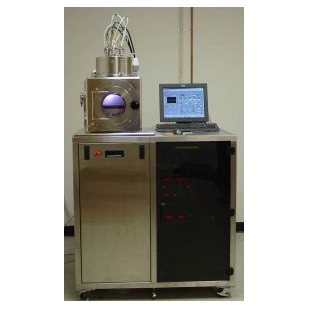 磁控溅射真空镀膜机 NSC-4000(M)磁控溅射系统 那诺-马斯特
报价:面议 已咨询 652次
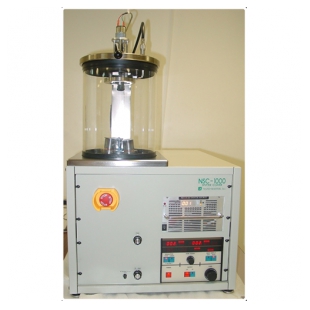 NSC-1000磁控溅射系统 那诺-马斯特 磁控溅射镀膜厂家
报价:面议 已咨询 590次
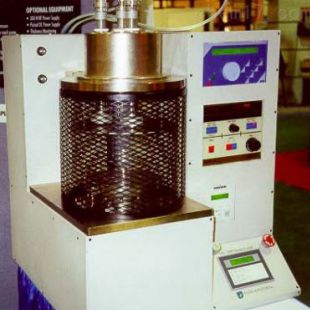 离子溅射仪 NSC-3000(M)磁控溅射系统 那诺-马斯特
报价:面议 已咨询 594次
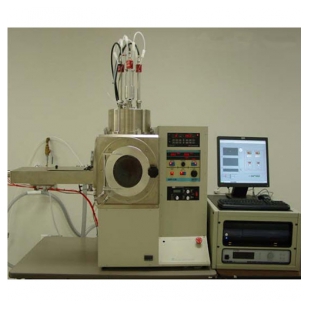 磁控溅射镀膜机 NSC-3000(A)全自动磁控溅射系统 那诺-马斯特
报价:面议 已咨询 577次
 磁控溅射设备 NSC-3500(M)磁控溅射系统 那诺-马斯特
报价:面议 已咨询 809次
 磁控溅射镀膜机 NSC-3500(A)全自动磁控溅射系统 那诺-马斯特
报价:面议 已咨询 1229次
 磁控溅射镀膜设备 NSC-4000(A)全自动磁控溅射系统 那诺-马斯特
报价:面议 已咨询 854次
 光学镀膜 NOC-4000进口光学镀膜机 那诺-马斯特
报价:面议 已咨询 382次
 看了该资讯的人还看了
2022-10-28
2022-07-28
2019-04-09
2019-05-05
2023-04-19
2023-01-11
 你可能还想看

 相关厂商推荐
①本文由仪器网入驻的作者或注册的会员撰写并发布,观点仅代表作者本人,不代表仪器网立场。若内容侵犯到您的合法权益,请及时告诉,我们立即通知作者,并马上删除。
②凡本网注明"来源:仪器网"的所有作品,版权均属于仪器网,转载时须经本网同意,并请注明仪器网(www.yiqi.com)。
③本网转载并注明来源的作品,目的在于传递更多信息,并不代表本网赞同其观点或证实其内容的真实性,不承担此类作品侵权行为的直接责任及连带责任。其他媒体、网站或个人从本网转载时,必须保留本网注明的作品来源,并自负版权等法律责任。
④若本站内容侵犯到您的合法权益,请及时告诉,我们马上修改或删除。邮箱:hezou_yiqi




 热点文章
热点文章
 近期话题
近期话题 相关产品
相关产品


 沪公网安备 31011502008050号
参与评论
登录后参与评论